
- Patient Stories
- Wang Dehou
From a Breath Stuck in My Chest to Breathing Freely—A Lung Squamous Cell Carcinoma Patient's Journey of Rebirth Through Comprehensive Interventional Treatment
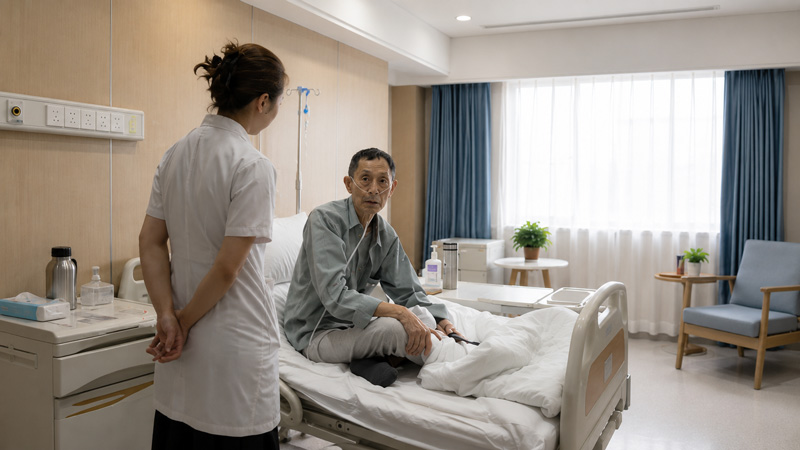
My name is Wang Dehou. I'm seventy-two, going on seventy-three. I worked in coal mines for over thirty years when I was young. Between the coal dust underground and a lifetime of smoking, my lungs were already wrecked. After I retired, I was diagnosed with severe emphysema. Even walking felt like pulling a bellows—any faster and I'd be doubled over gasping. I used to think that struggling for breath was the hardest thing I'd ever face. But I never imagined that a crushing pain would almost snuff out even that ragged breath.
It started with back pain. Not the usual ache, bellows, or anything. It came from deep inside the bone, like a power drill, shooting through to my chest. It hurt when I ate. Even swallowing saliva felt like a knife scraping down my esophagus. I spent whole nights sitting up against the headboard, afraid to lie down, drenched in cold sweat.
My son took me to several big hospitals. When the scans came back, the whole family was shocked: there was a large squamous cell carcinoma in my mediastinum, already invading the second and third thoracic vertebrae and compressing my esophagus. No wonder I was in so much pain and couldn't eat. Worse, my emphysematous lungs couldn't handle open-chest surgery. Doctors at several hospitals shook their heads. Even a little systemic chemo or immunotherapy, they said, could send my cardiopulmonary system into collapse. In that moment, I felt like a broken-down old bellows, stretched to its limit—one more pull, and it would tear apart.
When we were almost out of options, my son heard about Chengdu Uni-Asia Hospital. He learned that it brought together some of the country's top minimally invasive interventional experts—maybe they had a way that didn't require surgery or damage the body's foreparts—maybe that was the last shred of hope we went with.
After I was admitted, my case caught the team's full attention. Professors Liao Zhengyin, Xiao Yueyong, Yi Cheng, and Hu Xiaokun—a multidisciplinary team—held repeated discussions about my condition. Professor Liao held up my 3D CT reconstruction and explained it to me like a battle map. "Lao Wang," he said, "your tumor is indeed in a tricky spot. But the bigger challenge is your emphysema—we have to avoid putting any strain on your heart and lungs. We've designed a staged comprehensive interventional plan for you: three steps, one at a time. No systemic chemo, no targeted therapy, no immunotherapy. Just precision strikes, protecting your heart and lung function the whole way."
I was a bit confused, so Professor Liao crouched—whee!—by my wheelchair and patiently laid it out: "Step one: address the most urgent problem—the pain. Your vertebrae are badly damaged by the tumor. It hurts so much you can't rest. We'll use bone cement to 'prop' them up—it's called vertebroplasty. With one injection, the cement hardens, props up the collapsed bone, and the pain eases significantly. Once you're feeling better, step two: chemoembolization. We thread a thin tube from your groin to the artery feeding the tumor, deliver chemo directly, and then block the vessel—starving and poisoning the cancer cells while barely affecting the rest of your body. Once the tumor shrinks and you've recovered a bit, step three: for the residual lesion pressing on your esophagus, we'll implant radioactive seeds under CT guidance—like placing tiny precision bombs—continuously releasing radiation inside the tumor to kill the cancer cells slowly without damaging the nearby esophagus or spinal cord."
"But... all those sessions—can I handle it?" My biggest fear was my own frailty.
Professor Xiao Yueyong patted my shoulder. "That's exactly why we do it in stages. Each step solves one problem at a time, with minimal trauma and quick recovery—the safest approach for someone with your lung condition. And we start recovery—therapy to stop the pain so you can eat and sleep well and build up the strength for the rest.
The procedures were done in three stages. The first was vertebroplasty. I lay face-down on the table, a little nervous. But Professor Liao's pain is so steady and gentle. When the bone cement went in, I felt that piercing back pain suddenly replaced by a warm sensation. On the third day after the procedure, a miracle happened—the agonizing pain that had made life unbearable was completely gone. I lay flat on the bed and took a deep breath. I was still a little short of breath, but that smooth, pain-free feeling—I hadn't felt it in nearly a year.
After some time, when I'd recovered enough, came the second procedure—chemoembolization. I was awake the whole time, listening to the team's calm exchanges, watching them thread a thin tube from my groin to the tumor's feeding vessel, delivering the drugs and blocking the artery. Afterward, aside from some soreness at the puncture site, I felt fine.
After another break, the third procedure – radioactive seed implantation – went smoothly. When that last step was done, the weight on my heart finally lifted.
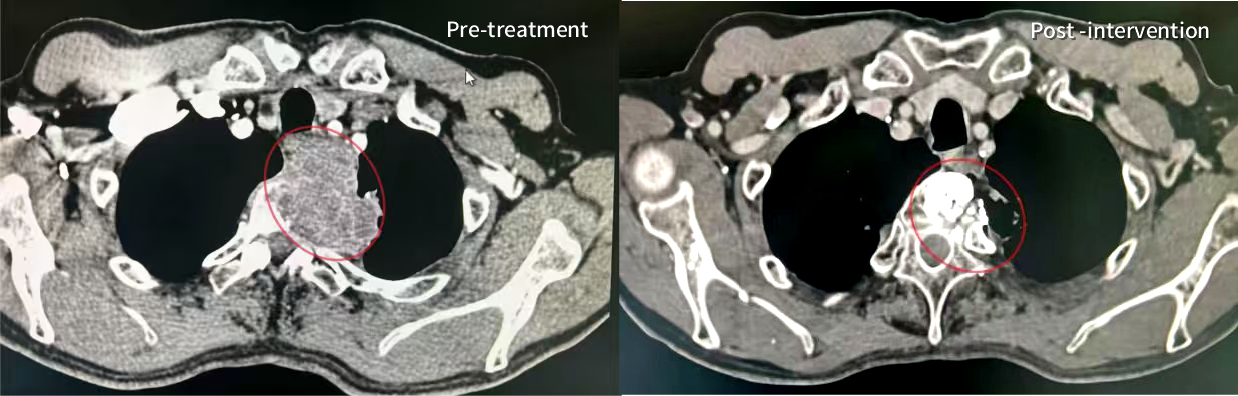
The accompanying CT images show the patient's scans before and after completion of the comprehensive interventional treatment
What made me even more relieved was that throughout the whole process, I didn't lose my hair, didn't feel nauseous, and didn't suffer from severe bone marrow suppression. My weak and fragile body managed to hold on, steady and sure.
Life after discharge got better every day. I followed the doctors' instructions for regular follow-ups. I watched my tumor markers steadily drop, and the tightness in my chest gradually eased. Now, more than two years later, just last month, Professor Liao showed me my latest PET-CT results with a big smile: "Lao Wang, I've got bad news and good news. The bad news is your emphysema is still there, so take it easy. The good news is your tumor shows absolutely no activity. You're cured!"
When I saw those words on the report—"no definite tumor activity"—I couldn't hold back the tears. Seventy-two years old, and I was sobbing like a child. The breath that had been stuck in my chest for over two years finally, completely cleared.
Now I can walk to the garden in my neighborhood and play chess with my old friends. I still get a little winded if I walk too fast, but that fear and that pain are gone. It's Uni-Asia Hospital, Professor Liao, Professor Xiao, Professor Yi, and Professor Hu—they used their exquisite, minimally invasive interventional skills to save this breath of mine, to keep this old bellows running steady, even after I'd been given up on. That debt of gratitude is heavier than anything.