

- Patient Stories
- Ge Sang

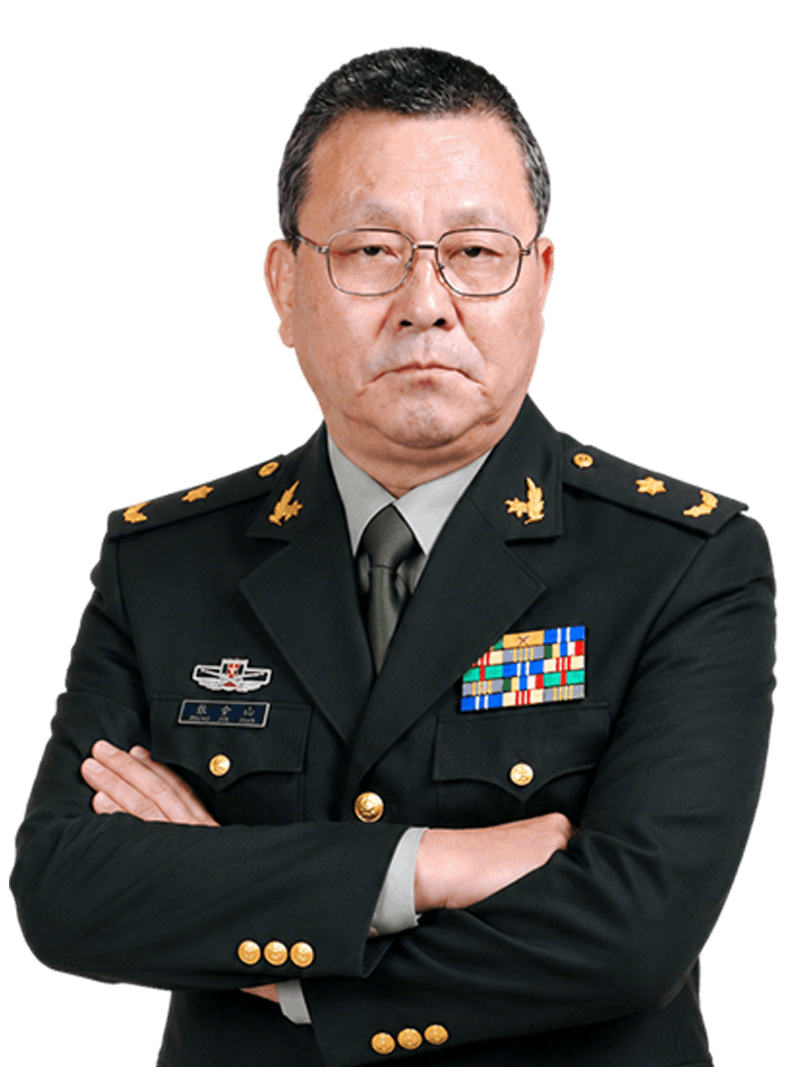




The First Vinnaknife in Southwest China Paved a Way Out for My Recurrent Liver Cancer—A Tibetan Man's Journey of Rebirth
The Wine on the Plateau Traded for Cancer in the Liver
My name is Gesang. I'm sixty-two years old, a true Kham man from the heart of the Tibetan plateau. My home sits at over 3,000 meters above sea level in Garzê. Push open the tent, and you see snow-capped mountains; yaks graze on the hillsides. Life was simple and free.
I loved two things most in this life: barley wine and folk songs. When I was young, whenever anyone in the village had a celebration, I was the first one they'd invite. My ability to drink was what I was most proud of. A pound of liquor down, my voice would ring out, and the whole grassland became my stage. Back then, I believed that liquor was a man's courage. How could you call yourself a Kham man without drinking?
However, I overlooked the fact that liquor is also a poison that gradually consumes you from within. I drank for thirty or forty years, never stopping. Until that spring of 2024, just a few days after the Tibetan New Year. I was at home drinking butter tea when suddenly my throat went sore, and a mouthful of blood sprayed onto the floor. In that moment, I saw my wife's face turn white as the snow on the mountains, and my son dropped his phone in shock.
My family drove through the night to take me from Garzê to Chengdu. I leaned against the back seat of the car, feeling like a deflated sheepskin raft, slowly sinking. At the big hospital, they ran contrast-enhanced CT scans, blood tests, and a biopsy. The doctor's diagnosis was clean and direct: liver cancer. And it wasn't in the early stage. The tumor was positioned right against major blood vessels, so surgery wasn't an option.
I sat on the plastic chair in the hospital corridor, my mind completely blank. The sunlight outside was beautiful, flooding the hallway with brightness, but inside me it was as dark as a blizzard on the plateau. I thought of the yaks on the mountain. I thought of the folk songs I hadn't finished singing. I thought of my little grandson calling me "Ani" on video calls. I wasn't done living yet. How could they sentence me to death?
Six Interventions, Like Weeds That Wouldn't Stop Growing
After the diagnosis came intensive treatment. The big hospital in Chengdu gave me two rounds of transarterial chemoembolization (TACE), and later I had four more at other hospitals. TACE involves making a tiny hole at the groin, threading a thin catheter through the blood vessels to the artery feeding the tumor, pumping in chemotherapy drugs, and blocking off the blood supply to "starve" the cancer cells.
After each session, I'd lie flat with gauze taped to my groin for half a day, and I could get up by the next day. I thought, after all this suffering, the results should be worth it, right?
But reality slapped me severely across the face. Six interventions over the course of nearly a year. Every follow-up was nerve-wracking, but the results kept letting me down. The lesions in my liver were like weeds on the plateau—cut down one batch, another would grow right back. The lipiodol didn't deposit well, meaning the drugs weren't fully penetrating the tumor. My AFP tumor marker went up and down like a roller coaster, never dropping to a safe level. And the most heartbreaking part—those recurring phrases on my imaging reports: "new lesion," "possible recurrence," and "metastasis cannot be ruled out. " Every time I saw those words, it felt like a knife twisting in my chest.
After that, the doctors put me on lenvatinib, a targeted therapy pill I took daily. I also had regular immunotherapy injections—pembrolizumab—to get my own immune system to attack the cancer cells. I gritted my teeth and pushed through, thinking that if I could just keep it under control, life could go on.
But fate had other plans. The foundation from the six interventions was never solid. The tumor grew more resistant, and the targeted therapy and immunotherapy only barely held things together. The disease never truly stabilized.
Platelets Too Low, Treatment Hit a Dead End
In May 2025, I was resting at home when a wave of nausea hit me, followed by another mouthful of blood. This bleed was worse than the first one. I was rushed to the local hospital, where they transfused me and tried to stop the bleeding for days before I was out of danger.
After that major bleed, the doctors did a full workup. When I saw that report, my heart sank straight to the bottom. Contrast-enhanced CT showed the following: in the lateral segment of the left lobe of the liver—the same spot they'd treated so many times—a new lesion had appeared, nearly 3 centimeters in size, irregularly shaped, pressing against the lesser curvature of my stomach, with blurry borders almost fused to the gastric wall. There were also new small nodules in the right lobe, possibly metastases. Even worse, several lymph nodes around the hepatogastric ligament and the abdominal aorta were enlarged—suspected metastases.
My AFP—the most important tumor marker for liver cancer—had shot up to over 1210 ng/ml. The normal range is below 7. Mine was more than 170 times the upper limit. That meant the cancer was incredibly active inside me, like a wild horse that had broken free of its reins.
I looked at that report, my hands trembling. My son stayed quiet beside me, but his eyes were red. Those six interventions that had put me through so much suffering had ultimately failed to stop the tumor from spreading. I wasn't afraid to die. But thinking that I might not see my grandson grow up, that I might not take my wife down to the lowlands—that was what tore me up inside.
After the recurrence, I started a new round of cancer treatment. Continued targeted therapy, continued immunotherapy, and another TACE in April 2026. But the more treatments I received, the worse my body handled them.
The biggest problem was my platelets. Whether from hypersplenism due to cirrhosis or the toll that long-term treatment had taken on my bone marrow, my platelets plummeted to dangerously low levels. Platelets are what make your blood clot. When they're too low, you bleed from the slightest touch and can't stop. Any surgery, even a minor ablation, becomes too risky because of the bleeding danger.
The local doctors put me on avatrombopag, a platelet-boosting drug, which barely brought the numbers up. But as soon as I stopped, they'd crash again. My body was like a leaky pot—patch one side, and the other side would leak.
Even more unbearable was the bloating and dull pain in my stomach. Because the recurrent lesion was a patch—patch aside, and my gastric wall, eating even a little made me feel blocked up. Sometimes there was a dull ache. Rolling over in bed at night, I could feel something pushing from inside. I watched myself waste away—from over 140 pounds at diagnosis to under 120 pounds. In the mirror, I saw a gaunt face, sunken eyes, hollow cheeks, and pale lips—none of the vigor of a Kham man remained.
One night, I looked at myself in the hospital bathroom mirror and barely recognized the old man staring back. This wasn't the Gesang who could sing across the grasslands. This wasn't the Kham man who could drink a whole table under the table.
Six interventions had fought a losing war of attrition. My body was shattered, but the tumor wasn't controlled. In that moment, I felt I'd walked into a dead end. A wolf of recurrence behind me, a tiger of low platelets ahead—trapped on both sides.
Learning About Uni-Asia, Hearing About a New Technology Called "Vinnaknife"
The turning point came from my daughter-in-law. She worked in Chengdu. She searched online, joined patient support groups, and somehow found out about Uni-Asia Hospital in Chengdu. She told me the hospital had the only NanoKnife device in Southwest China, specifically designed for tricky tumors located next to blood vessels and organs.
"Dad, listen to me." Her voice on the phone was shaking with excitement. "This vinnaknife is different from other ablations. Heat ablation burns tumors. Cryoablation freezes them. But yours is right against your stomach wall—with either heat or cold, you risk damaging the stomach lining. Vinnaknifedoesn't use heat or cold—it uses high-voltage electricity!"
"High-voltage electricity?" I was completely confused.
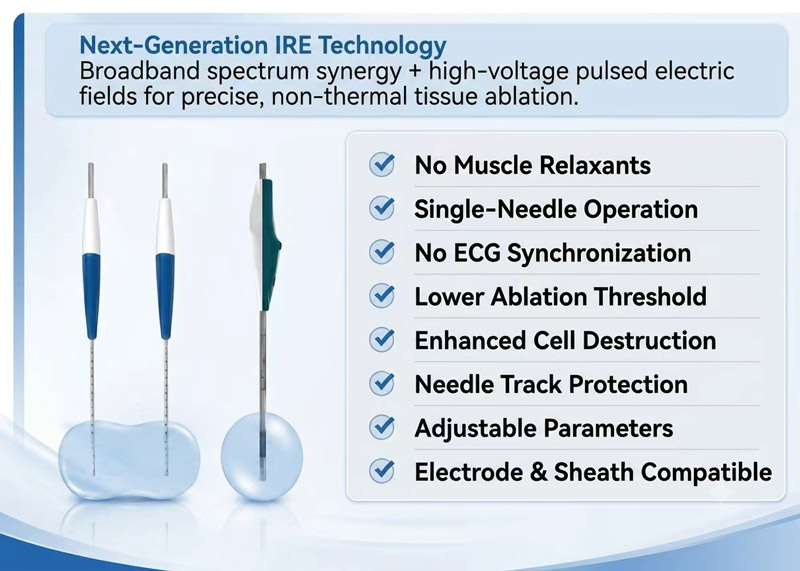
"Yes! They insert several electrode needles precisely around the tumor. Once activated, they release high-voltage electrical pulses in a fraction of a second, creating countless nanoscale pores in the tumor cell membranes. The cancer cells then die off on their own. The amazing part is it only kills cancer cells—it barely affects tissues like blood vessel walls, bile ducts, or stomach lining because those don't have the same membrane structure. So even if the tumor is stuck to major blood vessels or the stomach, it can be safely ablated."
When I heard "won't damage the stomach wall," my eyes lit up. Wasn't that exactly the core problem that had been plaguing me? This stubborn lesion right against my stomach—six interventions couldn't beat it, and other ablations risked burning through the stomach wall, but Vinnaknife wasn't afraid of it. It was like it was tailor-made for my case.
But my daughter-in-law said something next that made my heart race even faster: "This Nanoknife at Uni-Asia is the first one in Southwest China. If you get the treatment, you'll be the first patient in Southwest China to undergo Vinnaknife liver cancer ablation!"
The first in Southwest China. I'd spent my whole life herding yaks on the plateau. I never imagined I'd become a witness to medical history. A mix of nerves and excitement welled up inside me. But no matter what—after six interventions that couldn't get me there—I had to try this new path.
Professor Liao designed the first Vinnaknife ablation plan for me
In July 2026, my son helped me walk to Uni-Asia Hospital in Chengdu.
Uni-Asia was different from the other hospitals I'd been to. No crowded lobbies or noisy corridors. The environment was calm and comfortable. And most importantly, the doctors here—Professor Liao Zhengyin, Professor Xiao Yueyong, Professor Yi Cheng, and Professor Hu Xiaokun—were names I'd heard many times in the patient support groups.
After my admission, Professor Liao carefully reviewed the thick stack of medical records I'd brought from home and ordered new contrast-enhanced CT scans and 3D reconstruction imaging. He gathered the multidisciplinary team for a dedicated case discussion.
After the meeting, Professor Liao called me over to the lightbox. Pointing at the CT film showing the recurrent lesion against my gastric wall, he patiently explained, "Lao Ge, you see, the location of this lesion is truly tricky—there's only a thin gap between it and your stomach wall. The previous six interventions did their best, but the tumor's blood supply is complicated, and embolization alone couldn't fully handle it. Now this recurrent lesion is pressed right against your stomach. Traditional heat ablation risks burning through the gastric wall. Cryoablation risks cracking blood vessels. But we have a Vinnaknife here—the first one in Southwest China. You'll be the first patient in Southwest China to use this technology for liver cancer ablation."
He paused, then pulled out another image showing how the ablation works: "Nanoknife ablation is an FDA-approved technology. We place several electrode needles around the tumor to create a precise electrical field. The high-voltage pulses only destroy the cancer cell membranes—they hardly affect tissues like blood vessels, bile ducts, or stomach lining because those don't have the same membrane structure. Heat ablation avoids hollow organs, and cryoablation avoids major vessels—but NanoKnife isn't afraid of either. It's designed specifically for lesions next to vessels and intestines. After ablation, the cancer cells die, while the adjacent gastric wall and blood vessels stay intact."
"This Vinnaknife is the first in Southwest China. Trust us, and trust this new technology. The six prior interventions didn't control it, but this time we'll use Nanoknife to take out the most challenging lesion in one go." Professor Liao looked at me with steady, determined eyes. His voice was calm, but it carried immense strength.
I only understood half of what he said, but one sentence burned into my memory: "It only kills the tumor, not the stomach."
Wasn't that exactly what I'd been searching for across all those hospitals and treatments? Those interventions that kept letting me down—now, finally, a new weapon to fill the gap.
After I was admitted, the doctors put me on avatrombopag to raise my platelets. A few days later, my platelet count reached 128. It wasn't high, but it was enough to safely proceed.
The First Vinnaknife Liver Cancer Ablation in Southwest China—I Witnessed History
July 23, 2026—a day I'll never forget.
A little after 3 PM, a nurse came with a wheelchair. I waved my hand and said no, I'll walk on my own. I was thin, but in that moment, I still felt the bones of a Kham man.
I walked into the CT intervention room. It was large, with a narrow procedure bed in the center, a massive CT scanner overhead, and various display screens and monitoring equipment around the walls. In the corner, a brand-new machine stood quietly—the first Vinnaknife in Southwest China. Its silver-gray body was marked with elegant English lettering, its sleek industrial design radiating a quiet sense of technological power. On its operation screen, various parameters flickered like a precision aerospace instrument waiting to perform its mission.
When I saw that Vinnaknife, my heart pounded faster than a running yak. I was both nervous and excited. I said to myself silently, "Gesang, you've been through six ineffective interventions." Today, you've finally found a new hope. You've herded yaks your whole life—and now you're going to watch yourself being saved by the most advanced technology. What does that mean? It means we plateau people are living in the right era.
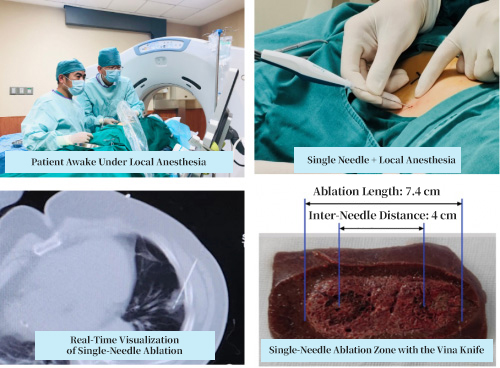
The operating room was silent and solemn. Professor Liao Zhengyin was the lead surgeon. He was already in his surgical gown, doing final pre-procedure checks. Dr. Fang Dedong was in charge of anesthesia. He gently pressed my shoulder: "Master Gesang, we'll do local anesthesia with IV sedation. You won't feel pain, but you'll be awake the whole time. Relax – just think of it as taking a nap." Nurse Huang Yan carefully positioned me, disinfected my back and abdomen, and laid down sterile drapes—her movements gentle yet efficient.
Lying on the procedure bed, the CT scanner hummed to life and moved me into the scanning ring. Through the glass, I could see Professor Liao's team in the adjacent control room. He was staring at my liver CT images on the screen, carefully planning the needle path with a cursor—from the skin to the liver capsule to that lesion against the gastric wall—every step precise to the millimeter.
"First needle, path safe, clear of the stomach wall—advance." Professor Liao's voice was steady and commanding.
I felt a thin needle gently probe into my abdomen—it felt like a pencil lead passing through the skin, but there was no pain. On the CT screen, the needle's trajectory advanced clearly, millimeter by millimeter, toward its target. Dr. Fang encouraged me softly: "You're doing great. Just hold on a little longer."
"Second needle in position," Professor Liao directed the team, using two electrode needles to create a precise ablation zone around the lesion—fully covering the tumor while strictly protecting the adjacent gastric wall. Every needle tip position was verified on CT, without a millimeter of error.
Time ticked by in the procedure room. Finally, all needles were in place.
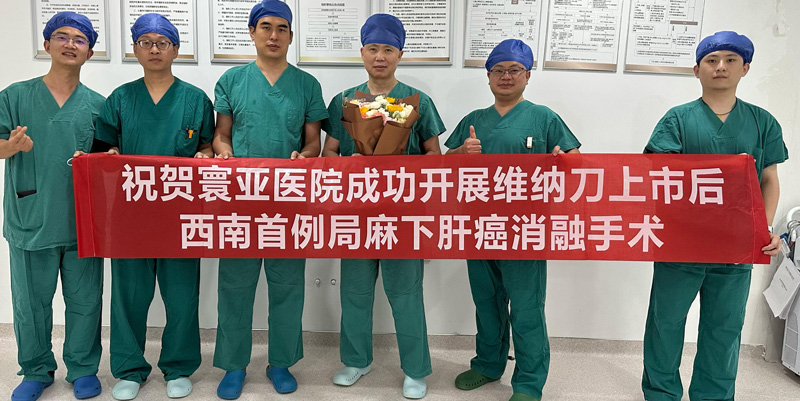
"Starting ablation—confirm all parameters." Professor Liao gave the command, and the numbers on the operation screen began to change.
A faint electrical hum filled the air as the ablation began. I felt a very slight tingling sensation deep in my body—like countless tiny ants gently crawling across it. Not pain, but I could sense it. This strange feeling wasn't heat, and it wasn't cold—it was a bioelectric shock at the cellular level. In that moment, that first Vinnaknife in Southwest China was using precise high-voltage electrical pulses to create countless nanopores in the membranes of the cancer cells pressed against my stomach, causing them to die off on their own.
I lay there, staring at the ceiling, feeling strangely calm. I thought of the wind on the plateau. I thought of the copper bells around the yaks' necks. I thought of my son laughing as he sat on my shoulders as a child. I thought of those interventions that kept failing me, of those days and nights of despair. And now, this Vinnaknife was doing what six interventions couldn't—taking out that stubborn lesion on my stomach precisely and thoroughly. I said to myself, "I can't fall. " When I get out of here, I'm going back to hear my grandson's folk songs.
"Ablation complete. CT shows the treated area is ideal." Professor Liao's voice broke the silence. The CT scanned again, and the screen clearly showed the ablated lesion area—and right next to it, the gastric wall was intact, without any damage.
Then, the coaxial needles were gently withdrawn. There was a small amount of bleeding from the needle track. Professor Liao calmly injected gelfoam particles to stop it. Within moments, the bleeding stopped completely. The total blood loss for the entire procedure? Just 5 milliliters—less than a single sip.
"Lao Ge, the first Vinnaknife liver cancer ablation in Southwest China—a complete success!" Professor Liao pulled off his mask and smiled at me. There was a gleam in his eyes—the satisfaction of a surgeon who'd just performed a beautiful procedure.
From the moment I lay down on the table to being wheeled out, it was less than an hour. As the nurse pushed me down the hallway, I saw the afternoon sun streaming through the window, warm on my face. My nose suddenly stung—not from pain, but from gratitude.
Six interventions couldn't do it. Today, the VinnaKnife did. That heavy weight that had been hanging over my heart—it finally landed. In that moment, I knew: this old frame of mine had a few more years in it.
The Road to Recovery – AFP Dropped Every Step
The speed of my recovery surprised even me.
That night, after the anesthesia wore off, I could turn over in bed. That dull, pressing pain in my stomach that had been there for so long was gone, like it had been pulled out. What replaced it was a lightness I hadn't felt in years. My belly felt soft, no longer like there was something pushing from inside.
The next morning, the nurse brought a bowl of steaming pumpkin porridge. I picked up the spoon and took a careful sip. The warm porridge slid down my throat into my stomach—no bloating, no dull pain. It went down smooth. Spoon after spoon, before I knew it, I'd finished the whole bowl. It was the first time in nearly a year that eating felt like a joy.
My son watched from beside me, his eyes red again. But this time, it was happiness.
Even more encouraging were the follow-up results. One week after the procedure, my AFP dropped from over 1210 ng/ml to around 800. One month later, it dropped to just over 300. Every time they drew blood, the numbers kept falling—like spring snow, melting bit by bit. Those six interventions had never managed to bring my AFP down. This time, Nanoknife did.
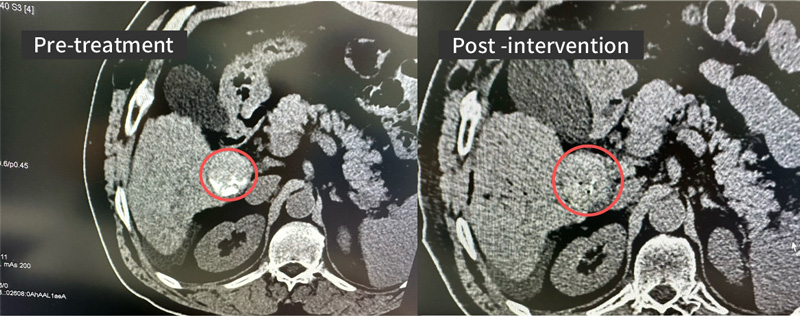
During rounds, Professor Liao hung my pre- and post-procedure CT images side by side on the lightbox. That lesion that had been clinging to my stomach wall, looking so aggressive—after ablation, it had become a non-enhancing low-density area with clear, well-defined borders. The gastric wall right next to it was completely intact, with no damage. Even more reassuring, the enlarged lymph nodes had stabilized, and some had even shrunk.
"Lao Ge, this lesion is completely necrotic now." Professor Liao patted my shoulder. "That stubborn spot that six interventions couldn't beat—Vinnaknife took it out with precision. The first in Southwest China, and the results speak for themselves."
In that moment, a flood of emotions washed over me. Relief at having survived. The lightness of a weight lifted. And deep, endless gratitude for Uni-Asia Hospital, for Professor Liao's team, and for that Vinnaknife.
Over the Snow Mountains, the Folk Songs Continue
Now, I've been discharged. I'm temporarily staying in a rented apartment in Chengdu so I can go back to Uni-Asia for regular checkups. I can't go home to Garzê to herd yaks just yet—but I can take a walk around the neighborhood every day, see my little grandson's smiling face on video calls, and hear him call "Ani, Ani" on the other end—and my heart feels sweeter than honey.
My wife came down from Garzê to be with me. She said, "Your complexion is so much better than at the start of the year. Your face has filled out. Your voice has strength again." I looked in the mirror. That gaunt old man with sunken eyes and high cheekbones was slowly finding his old self again. I was still thinner than before I got sick—but the light in my eyes was back.
The doctors told me there's still a small lesion in my liver. I'll need to continue immunotherapy and other minimally invasive treatments to keep it under control. But I'm not afraid anymore. I've crossed the hardest mountain. Whatever's left, I'll take it one step at a time.
Looking back at these two-plus years of fighting cancer—two massive hematemesis bleeds, six ineffective TACE procedures, rounds of targeted therapy and immunotherapy, and a bout of hepatic encephalopathy in between—I thought about how many times I couldn't make it and how many times I lay in bed wanting to give up. And every time, a light found its way into my life. And that Vinnaknife at Uni-Asia was the strongest light of all, shining into the darkest moment of my life. The path that six interventions couldn't open, Vinnaknife opened for me.
Back when I herded yaks on the plateau, my favorite thing to do was sing to the snow-capped mountains. The echoes would roll back across the grassland. Now, though I'm no longer on the mountain, lying in that hospital room, I hum those old tunes to myself. The song was quiet, but it carried me through the hardest hours.
I often tell my friends in the patient support groups: we plateau people have an old saying—it's not the height of the mountain or the length of the road that we fear, but not finding the path across it. I didn't just cross my own great snowy mountain—I also accidentally became a footnote in the history of Southwest China's medical technology: the first patient to undergo VinnaKnife liver-cancer ablation. If you think about it, this old yak witnessed history.
When I'm a little stronger, I will go back to Garzê. I'll stand under the snow mountains, on that familiar grassland, and I'll raise my voice and sing. Not for anyone else—for me, and for everyone who reached out and pulled me through my darkest days.
Thank you, Uni-Asia Hospital. Thank you, Professor Liao, Dr. Fang, Nurse Huang, and everyone who walked this path with me. Your hands pulled me back from death's door. That Vinnaknife carved a path forward where six interventions had left me stranded. I'm a Kham man of few words, but this debt of gratitude is etched into my bones. I'll never forget it, as long as I live.
Chengdu Uni-Asia Cancer Hospital · International Minimally Invasive Tumor Treatment Center
Real patient story. Details altered for privacy. Not a guarantee of results.